
In our future scenario, the population of Hong Kong is constantly on the rise. On the one hand, the city becomes space-starved and the land becomes really expensive. On the other hand, the government decides to abolish dual nationality policy in order to cope with the overpopulation issue. Under this circumstance, the young generation has a greater likelihood of choosing to leave Hong Kong and to explore the world outside whereas the old generation chooses to stay as they are more familiar and comfortable with Hong Kong’s environment.
The inspiration of my prototype comes from the cage houses that exist in Hong Kong today and the number of people and the limitation of land space that Hong Kong will have in 2050. I wanted the apartment to be modern, clean and simple. The idea of the prototype lays emphasis on designing in a small space and its multifunctionality and creating a comfortable dwelling condition for couples.
These apartments will be established by the government in 2050 in order to solve ‘more people, less land’ issue. With the successful development of Hong Kong’s technology and economic, the government has the human, technological and financial resources to achieve this project in the future. People can either rent the apartment or buy it if they have the money. The apartments should be reasonable and affordable as it is a government investment and the construction and decoration are uniformly designed.
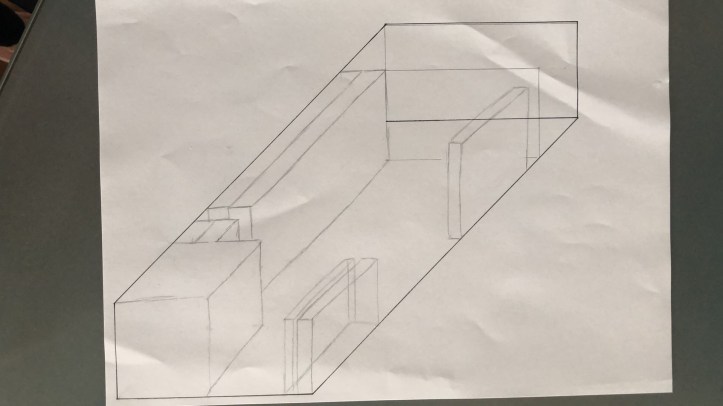
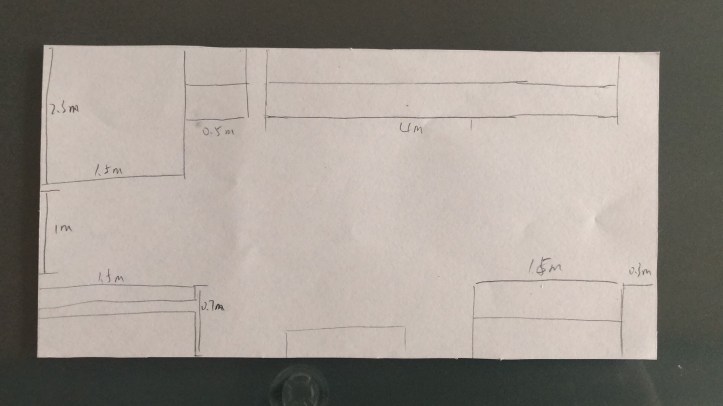
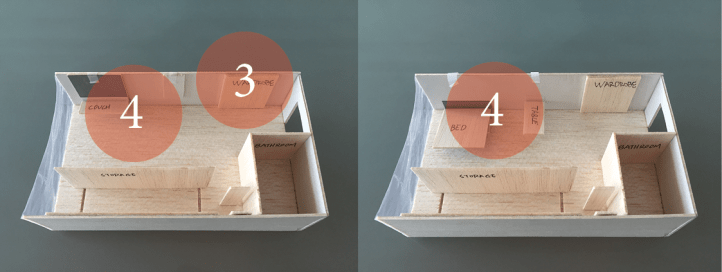
The size of the apartment is 28 square metres, 4 metres wide and 7 metres long and nearly everything is concealed. In this apartment, the walls can be slide, the bottom of the walls installs wheels and the top of the walls is attached to the ceiling as I didn’t want to have tracks or guides on the floor. As shown in the figure, the kitchen area (area 1) is hidden behind the wall. When the kitchen is needed, the user simply needs to pull the wall out; and when the kitchen is not needed it disappears by pushing it back. The same concept applies to laundry (area 2) and wardrobe (area 3) areas. Area 4 contains a couch and behind is a murphy wall-bed. On the right, it’s a murphy built-in table, to fold it up when needed and fold it back down when not in use. These operations are very practical for a small space as it is unlikely to occupy the space. The design conveniently hides things are not necessarily needed all the time and thus gives the residents an extra luxury area which can be used for any other activities.

 Kool Kids Klub