
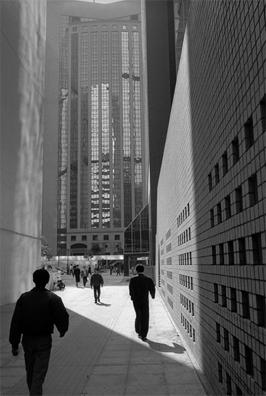
Photo: Patrick Zachmann – Wan Chai business district – 1992
Through taking a critical analyse of two texts; “Hong Kong as a labortory or the future” by Ezio Manzini and “Buildings and energy trends” by the Rand corporation, key ideas repetitively arise which strongly connect the two texts. Hong Kong as a Lab of the future elaborates on the extremities of the highly dense environment that is constantly growing although thought to have only been a place specific experience of western and Chinese cultural integration but have migrated to other places in the world as well as their energy trends and social experiments. With the scope of the visible future being a hyper populated world high density living will be a diffuse way of organising urban space.
With “ongoing processes of globalisation” and the spreading of ideas and resources; energy presents itself as a large economic sector and with a hyper populated future for example like in Hong Kong where there are approximately 7 million residents on 2,754 km² we need to ask questions on what happens when we peak our fossil fuel consumption by 2040? What happens when we run out of fossil fuels? Is there enough to go around? Is an efficient resource? What are other energy alternatives? What are the pros and cons? What are the challenges we will face in the future, because of the energy we use today?
Inayatullah’s Six basic pillars of questions and methods help deepen the research and future thinking of energy. Questions we should think about regarding the future of energy are:
- What will it be like in the future of energy?
- What are we trying to avoid?
- What are the hidden assumptions?
- Are there any alternatives?
- What is the preferred future of energy?
- How can we get there?
Hence companies generating an array of alternatives and theories such as hydrogen fuelled cell batteries yet it produces less energy than it takes to make the battery. Other ideas include Nuclear fission, electrolysis of matter.
Solutions to high demanded energy:
1/ energy as a service
This idea of energy as a service deviates from the idea of tradition power purchase agreements and energy management services. The idea is that an outside service company will guarantee a building’s future costs. If the building’s use more energy than predicted then the company will be responsible for these differences. If the building’s use less energy than predicted than the company will profit. From the consumer perspective it is a way of cost management of overhead electrical costs on a day to day fluctuation scale rather than a yearly scale and for many energy companies it is a creative way to supply energy and pushes for energy efficiency improvements.
2/ decentralised energy and digital technologies
This idea is an opposite to the tradition power distribution models. It consists of having a large number of small capacity units that are all connected by a power grid, natural gas and cooling and heating platforms to generate local sourced renewable energy. With Localised energy there is a higher rate of efficiency and density since the energy does not have to travel long distances which from this transmission heat is lost.
Through the texts the main messages were the shift towards renewable energy and efficient solutions in a creative innovative tone. Companies and consumers are recognising the problems and devastating effects of fossil fuels and mining on the environment and predictions of depleting resources of our coal and oil reserves expected to completely run out in 2088. Hence the demand and rush to find new alternatives to combat this issue. Finding better solutions for energy than the ones we have that negatively impact our environment and the health of workers.
References
ARTICLES
Beth E. Lachman, Agnes Gereben Schaefer, Nidhi Kalra, Scott Hassell, Kimberly Curry Hall, Aimee E. Curtright and David E. Mosher, 2013, Chapter Title: Buildings and Energy Trends, RAND Corporation, Jstor, viewed on the 17 August 2018
E. Manzini, 2013, Hong Kong “labortory of the future”, Rand Corp, Jstor, viewed on the 17 August 2018
Killian. E, 2017, The emerging Business model of energy as a service, building energy resilience, CX associates, viewed on the 17 August 2018
<https://buildingenergy.cx-associates.com/the-emerging-business-model-of-energy-as-a-service-eaas>
Inayatullah. S, 2007, The six pillars: futures thing for transforming, Sohail Inyatullah, emerald insight, viewed on the 17 August 2018
<https://www.emeraldinsight.com/doi/abs/10.1108/14636680810855991>
IMAGES
P. Zachmann 1992, Wan chai business district, Artstor Image, viewed on the 17 August 2018 <http://library.artstor.org.ezproxy.lib.uts.edu.au/#/asset/AMAGNUMIG_10311556323;requestId=6d6073277c2f0e6e895f110bbc52f134>
 Kool Kids Klub